
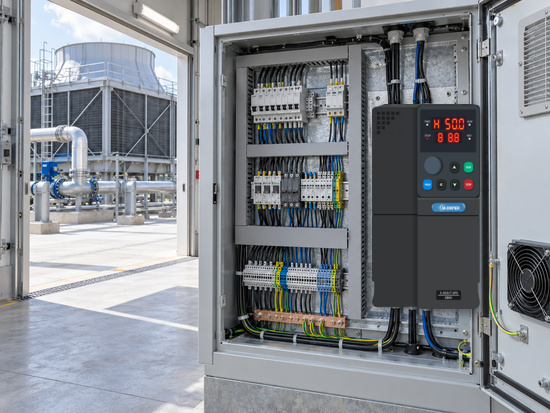
A cooling tower fan VFD should be selected from motor current, fan duty, the control target and the operating environment—not motor kilowatts alone. The drive is only one part of the system. A reliable design must also consider water-temperature feedback, minimum fan speed, motor cooling, vibration zones, fan staging, cabinet protection and the way the tower will operate when a drive is unavailable.
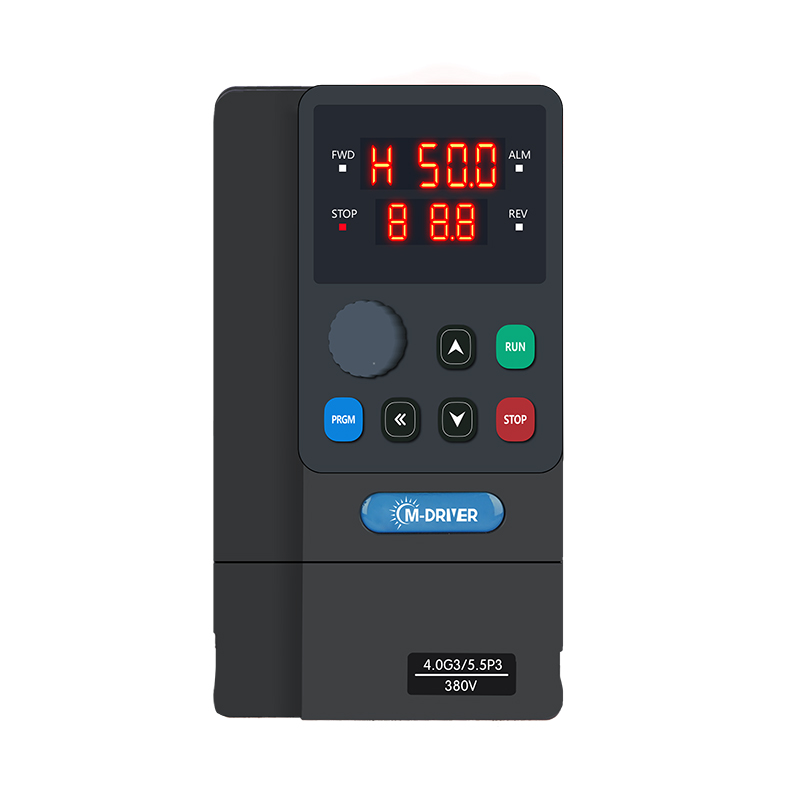
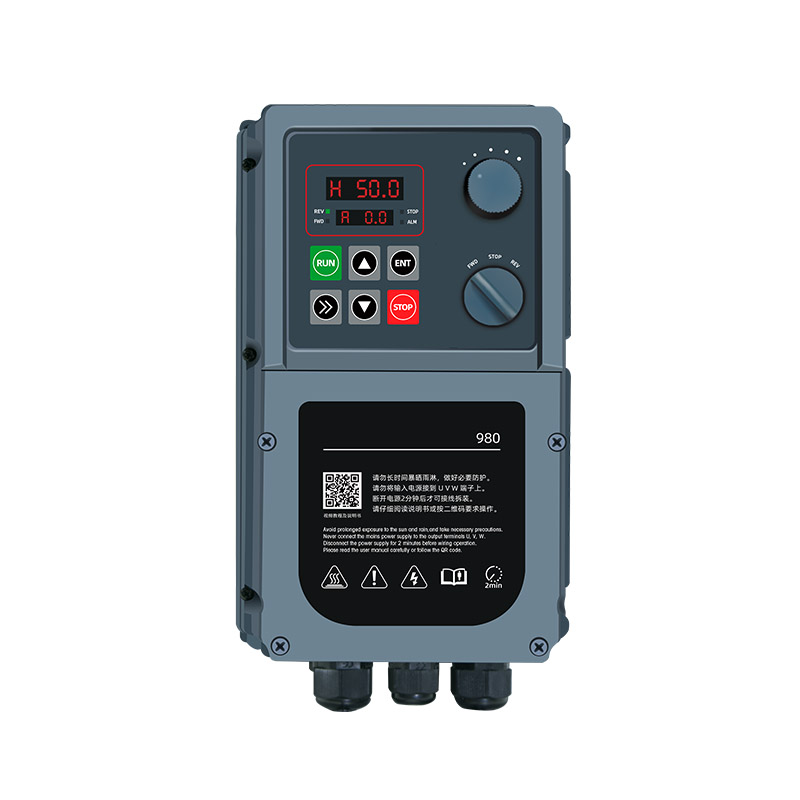
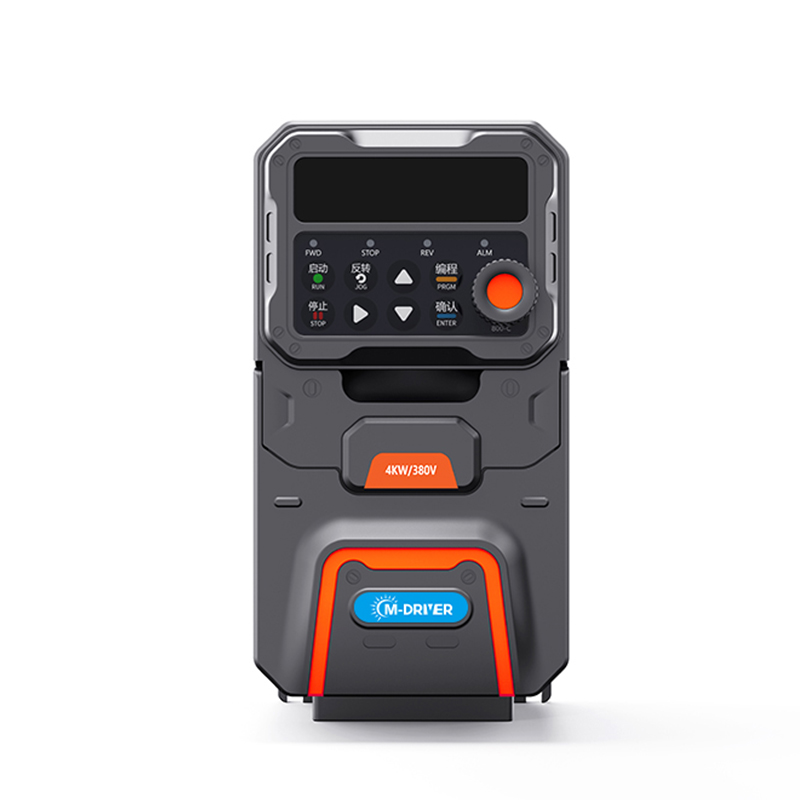
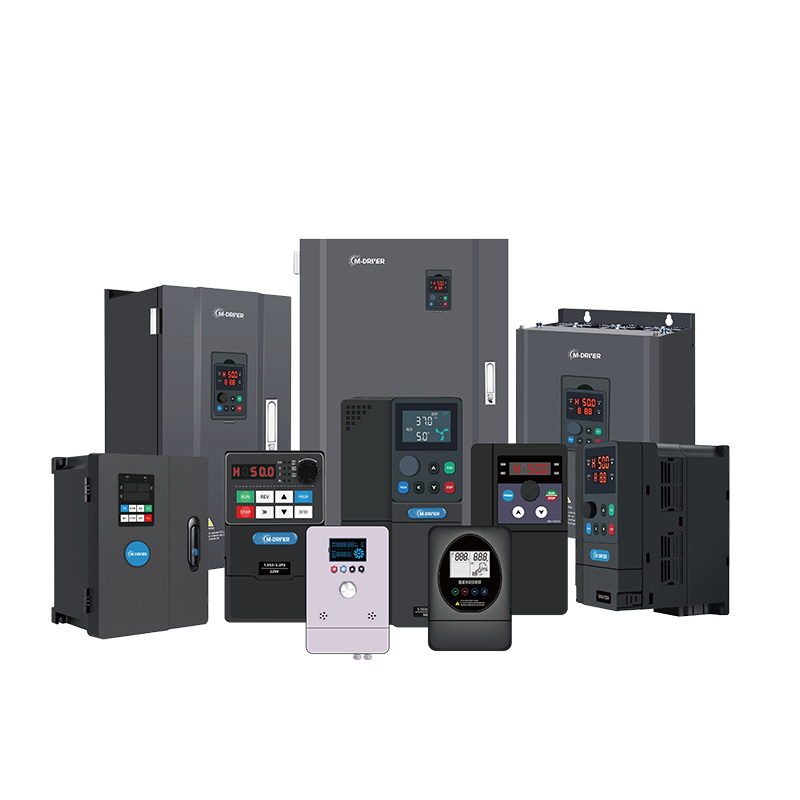
The M-Driver 900 Series Fan and Pump Variable Frequency Drive (VFD) provides open-loop vector and V/F control, built-in PID, 0–10 V and 4–20 mA analog inputs, Modbus communication and preset-speed operation. These functions can support a cooling tower control system when the selected model, cabinet and accessories are matched to the actual motor and site.
Start With the Cooling Duty
Before selecting a drive, define what the cooling tower must control. The feedback variable may be leaving-water temperature, condenser-water temperature, condenser pressure or a command from a building management system. These are not equivalent control objectives.
Record the design wet-bulb condition, required water temperature, normal and peak heat-rejection load, number of cells, number of fans per cell and whether the fans are staged or modulated together. Also record seasonal operating modes, low-temperature protection and any plume-abatement strategy. A VFD can vary fan speed, but it cannot correct a tower that is mechanically undersized or has poor water distribution.
Size the VFD From Motor Current and Duty
Capture the complete motor nameplate
Provide rated voltage, rated current, power, frequency, speed, power factor, efficiency, insulation class and duty. Confirm whether one VFD supplies one motor or multiple motors. When several motors share one drive, each motor normally needs appropriate individual protection, and all motors follow the same output frequency.
Motor rated current is the primary electrical reference. Two motors with the same kW can have different full-load currents. The drive output-current rating must cover the motor current after accounting for ambient temperature, altitude, cabinet temperature and the required duty. Do not use a pump or fan label as permission to ignore current.
Describe starts, stops and seasonal load
Cooling tower fans often run for long periods, but they may also cycle during light load or shoulder seasons. Record expected operating hours, starts per hour, minimum run time, speed range and whether the fan reverses for de-icing or cleaning. Reversal must be confirmed against the fan, gearbox and tower manufacturer’s limits; it is not a generic VFD function to enable without review.
Use Fan Laws as a Starting Point, Not a Guarantee
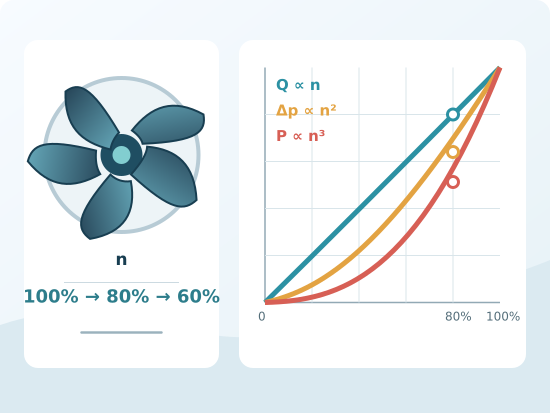
For a geometrically unchanged fan operating in a comparable air system, airflow varies approximately with speed, pressure with speed squared and power with speed cubed. At 80% speed, the theoretical fan power is about 0.8³, or 51.2% of the full-speed value.
That calculation is useful for understanding why variable-speed control can reduce power at partial load. It is not a guaranteed site saving. Actual results depend on tower heat load, static pressure, fan and motor efficiency, water distribution, control stability, minimum-speed limits and the time spent at each operating point.
Choose the Control Signal and PID Strategy
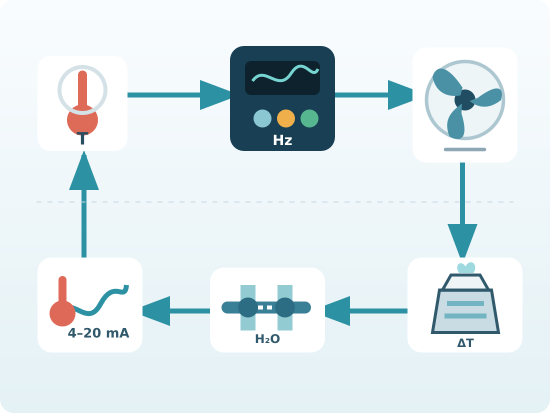
The M-Driver 900 Series Fan and Pump VFD can accept 0–10 V and 4–20 mA analog signals and includes PID control. A temperature transmitter can therefore provide feedback directly to an engineered loop, or a BMS/PLC can calculate the speed command and send it by analog signal or communication.
Whichever architecture is used, define:
- the controlled variable and sensor location;
- engineering range and signal-loss behavior;
- temperature setpoint and deadband;
- minimum and maximum frequency;
- acceleration and deceleration times;
- sleep, restart and staging logic where applicable;
- manual, automatic and bypass command priority;
- alarm reporting and fallback speed.
A sensor placed in a poorly mixed pipe section can create unstable control even when the PID settings are reasonable. Confirm the measurement location before tuning the loop.
Establish a Safe Minimum Speed
The lowest electrical frequency is not automatically the lowest acceptable fan speed. A practical minimum must respect several constraints.
Motor cooling
A shaft-mounted motor fan moves less air at low speed. Long operation at high torque and low speed can increase motor temperature. Review the motor manufacturer’s allowable speed and load range; use independent ventilation if the duty requires it.
Fan and gearbox lubrication
Gear-driven towers can have minimum-speed or lubrication requirements. Belt drives also have tension and resonance considerations. Follow the mechanical equipment limits.
Tower water and air distribution
Very low airflow may cause poor thermal performance, icing risk or unstable cell-to-cell control. The tower supplier should define any process minimum.
Resonance
Large fans, long shafts and tower structures can have critical speed bands. During commissioning, sweep the permitted range while monitoring vibration. Program skip frequencies only after the problem band has been measured; do not copy values from another tower.
Coordinate Multiple Fans and Cells
When several tower cells operate together, decide whether to modulate all available fans at similar speed or stage cells on and off. Running more fans at lower speed can be efficient in some systems, while minimum-speed, plume, icing and water-distribution requirements may favor staging in others.
Avoid a control sequence that repeatedly starts one fan while another remains near its minimum. Add sensible deadband, minimum run time and stage delay. If fans share a common temperature signal, check that commands do not fight each other.
Design for the Real Environment
Cooling towers are wet, often outdoor installations. The M-Driver 900 Series Fan and Pump VFD is an IP20 indoor product, so it must be installed in a suitable enclosure with the required ingress protection, corrosion resistance, temperature control and condensation management.
Do not place the drive where tower drift or chemical vapor can be drawn directly through it. Use a cabinet layout that separates clean cooling air from wet process air. Keep cable entries sealed, provide drainage where appropriate, maintain clear airflow paths and select heaters, fans or heat exchangers from a cabinet heat calculation—not by visual guesswork.
Outdoor cabinets also need solar-load, low-temperature and condensation review. A high enclosure rating alone does not guarantee acceptable internal temperature.
Plan Bypass and Maintenance Deliberately
A bypass can keep a fan available during drive service, but it changes how the motor starts and how protection is coordinated. Define whether bypass is manual or automatic, how interlocks prevent simultaneous connections, and whether direct-on-line starting is acceptable for the motor, supply and mechanical system.
Provide an isolating method that supports safe maintenance. If the process needs continuous cooling, consider cell redundancy and spare strategy rather than relying only on a bypass contactor.
Commission the Complete System
- Verify the motor, supply, grounding, fan rotation and mechanical readiness.
- Enter the correct motor data and confirm the selected control mode.
- Test local run at low speed and verify rotation before coupling to automatic control.
- Check current, vibration and motor temperature across the permitted speed range.
- Identify and document any resonance exclusion bands.
- Calibrate the temperature signal and confirm sensor-loss response.
- Tune the PID gradually; avoid aggressive settings that cause speed hunting.
- Test staging, manual/automatic transfer, alarms and bypass interlocks.
- Record baseline current, vibration, temperature and operating frequency for maintenance.
Cooling Tower VFD RFQ Checklist
Send the following with a quotation request:
- motor nameplate and fan/cell quantity;
- supply voltage and frequency;
- one drive per motor or multiple motors per drive;
- design water temperature and feedback signal;
- minimum and maximum fan speed;
- direct drive, belt drive or gearbox details;
- expected ambient temperature, altitude and cabinet location;
- dust, moisture, drift and corrosive-vapor conditions;
- motor cable length and communication requirement;
- bypass, isolation, redundancy and alarm requirements.
Common Selection Mistakes
Matching only the kW value
The drive must cover actual motor current and the environmental duty. The kW label alone is incomplete.
Promising savings from the cube law alone
Fan laws describe a relationship, not a site guarantee. Measure the duty profile and include every system constraint.
Setting an arbitrary minimum frequency
The motor, fan, gearbox, tower process and structural vibration may each impose a different limit.
Installing an indoor drive beside the tower without a cabinet study
Moisture, drift, solar heating and condensation can defeat an otherwise correct electrical selection.
Tuning PID before validating the sensor
An unstable or poorly located sensor produces unstable speed control. Fix the measurement first.
FAQ
Should a cooling tower fan VFD be sized by kW or current?
Use the motor rated current and required duty as the primary electrical references, then confirm supply, cabinet temperature, altitude, speed range and control requirements. Motor kW alone is insufficient.
How much energy can a cooling tower fan save with a VFD?
There is no universal percentage. Fan power can fall rapidly with speed under fan-law conditions, but actual savings depend on the load profile, minimum speed, control method and system efficiency. Use measured operating hours and speeds for an estimate.
What is the minimum frequency for a cooling tower fan?
There is no universal value. Confirm motor cooling, gearbox or belt limits, water distribution, icing, vibration and tower-manufacturer requirements, then validate the range during commissioning.
Can one VFD run several cooling tower fan motors?
It may be possible when the motors always run at the same speed and the design includes suitable individual motor protection. Independent control, redundancy or unequal motor sizes usually favor one drive per motor.
Does an IP20 VFD work outdoors?
Not by itself. Install it in an engineered enclosure that provides the required ingress, corrosion, thermal and condensation protection for the site.
Build the RFQ Around the Tower Duty
For a cooling tower project using the M-Driver 900 Series Fan and Pump VFD, send the motor nameplate, number of fans, target water temperature, minimum speed, cabinet environment and control architecture. M-Driver can then review the drive current, signal interfaces and installation requirements as one system.Contact Us!